Far from the spotlight of frontline warships, the US Navy’s John Lewis-class fleet replenishment oilers operate where endurance is decided — not in combat, but in logistics.
These ships do not fire missiles or launch assaults; instead, they deliver fuel, provisions, and supplies to warships at sea, enabling continuous operations without returning to port.
In modern naval operations, that sustainment capability is what allows fleets to maintain global reach and presence.
To understand naval power, you have to understand the logistics that keep it moving, so let’s take a closer look.
What It Is
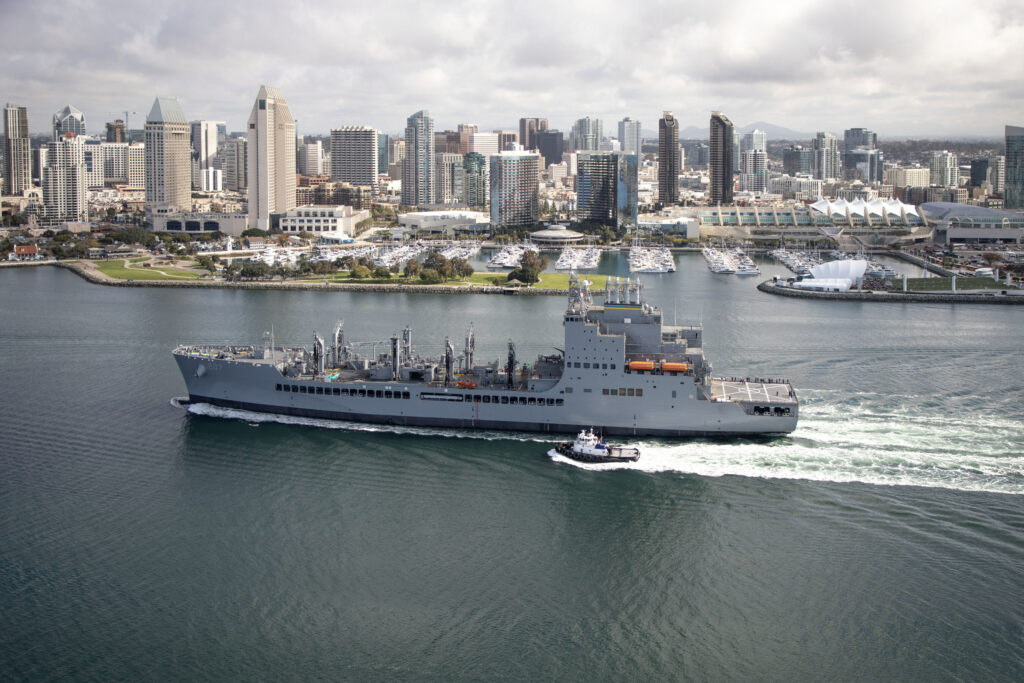
The John Lewis-class fleet replenishment oiler (TAO-205) is a new generation of fleet replenishment ships purpose-built to sustain naval operations far from shore.
At its core, it serves as a mobile logistics hub at sea, delivering fuel, provisions, and mission-critical supplies directly to warships while underway, eliminating the need for frequent port visits.
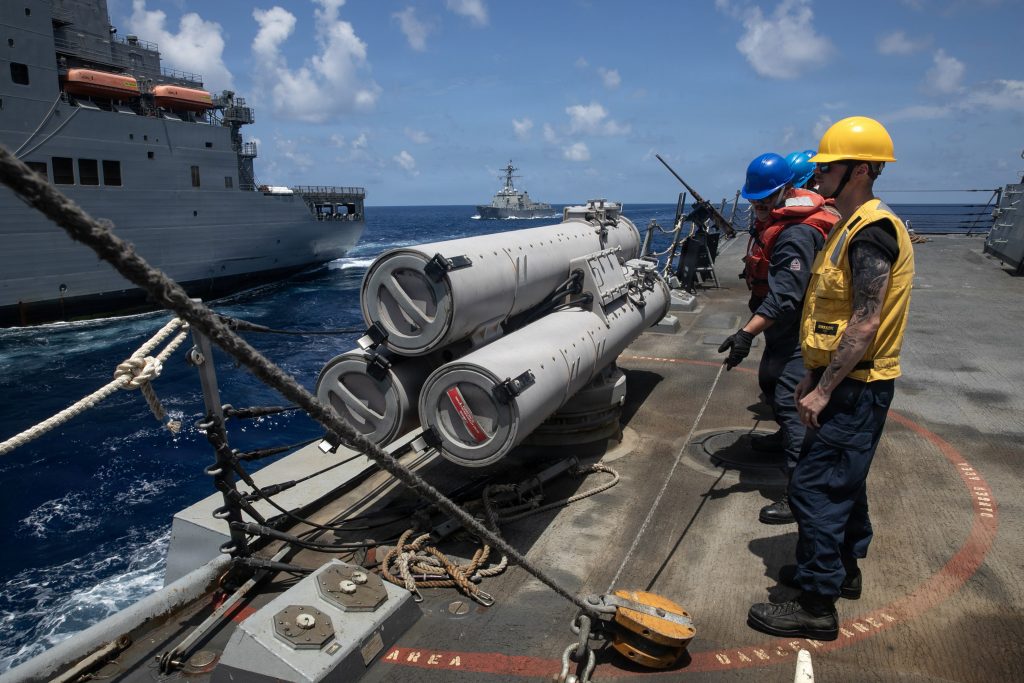
These oilers primarily carry large quantities of marine diesel and aviation fuel, which are transferred to receiving ships through underway replenishment, a process where vessels sail side-by-side and exchange fuel via connected hoses.
In addition to liquid cargo, they can also support vertical replenishment using helicopters to move supplies such as spare parts, food, and limited ammunition.
| Category: | Details: |
| Type | Fleet Replenishment Oiler |
| Displacement | 41,225 tons full load (double hull), 40,900 tons full load (single hull) |
| Length | 206.5 meters (677.5 feet) |
| Beam | 29.7 meters (97.5 feet) |
| Draft | 10.9 meters (36 feet) |
| Crew | 74 to 89 civilian mariners |
| Propulsion | 2 × diesel engines, single shaft |
| Speed | ~20 knots (23 miles/37 kilometers per hour) |
| Range | Virtually unlimited with logistics cycles |
| Fuel Capacity | 180,000 barrels of aviation and diesel fuel |
| Cargo Capacity | Dry cargo, ammunition (limited), provisions |
| Aviation Facilities | Helicopter deck (no hangar) that can support MH-60 Seahawk, MH-53E Sea Dragon, and CH-53E Super Stallion |
| Replenishment | Multiple underway replenishment stations |
| Procurement Cost | More than $900 million per unit |
Origins and Development
The John Lewis-class fleet replenishment oiler program emerged from a clear operational need: replace the aging Henry J. Kaiser-class oilers, which date back to the 1980s.
The US Navy launched the T-AO(X) program in 2016 to field a more efficient, resilient, and cost-effective logistics platform capable of supporting distributed forces.
General Dynamics NASSCO was awarded the contract to design and build the new class, leveraging a commercial-based ship design to streamline construction and reduce lifecycle costs.
USNS John Lewis, the lead ship, was delivered in 2022, marking the start of a planned 20-ship program intended to recapitalize the US Navy’s Combat Logistics Force.
How the John Lewis-Class Fleet Replenishment Oilers Work
Equipped with modern automation and efficient transfer systems, the John Lewis-class oilers streamline underway resupply, reducing crew demands while enhancing reliability and operational flexibility.
Replenishment Process
The replenishment sequence follows a precise choreography:
- Rendezvous: The oiler meets the receiving ship at sea at a predetermined location.
- Station-keeping: Both vessels sail parallel at close distance, maintaining steady course and speed.
- Connection: Fuel hoses and transfer lines are rigged between ships.
- Transfer: Fuel and other supplies are pumped across while both ships remain underway.
- Disconnect: Lines are secured, and ships safely separate, ready to resume independent operations.
Key Features
- Underway replenishment capability: Supports continuous resupply without requiring port calls, keeping naval forces mission-ready.
- Fuel efficiency: Modern engines reduce operational costs and emissions compared to older oilers.
- Automation: Advanced systems lower crew requirements while increasing operational reliability.
- Aviation support: A helicopter deck enables vertical replenishment, allowing cargo and supplies to be delivered directly to ships beyond the line-of-sight.
Strengths
- Force multiplier: Extends operational endurance of entire fleets
- Global reach: Supports sustained deployments far from home ports
- Interoperability: Compatible with allied naval forces
Limitations
- Non-combatant role: Minimal self-defense capability
- Dependency risk: Fleet operations rely heavily on availability
- Vulnerability: Requires protection in contested environments
Global Use and Operations
Though relatively new, the class is already supporting global US Navy operations, particularly in the Indo-Pacific and the Middle East.
These oilers routinely sustain carrier strike groups, amphibious ready groups, and independent deployments.
Their role is especially critical in vast operational theaters where port access is limited or politically constrained. By enabling continuous at-sea logistics, they underpin everything from deterrence patrols to humanitarian missions.

Future Outlook
The John Lewis-class represents a shift toward more resilient and efficient naval logistics. As distributed maritime operations become more prominent, demand for flexible and survivable supply ships will increase.
Future developments may include integration with autonomous resupply systems, enhanced defensive capabilities, and expanded multi-mission roles.
While they may never command headlines, these oilers will remain indispensable, quietly ensuring that naval power can stay on station, anywhere in the world.