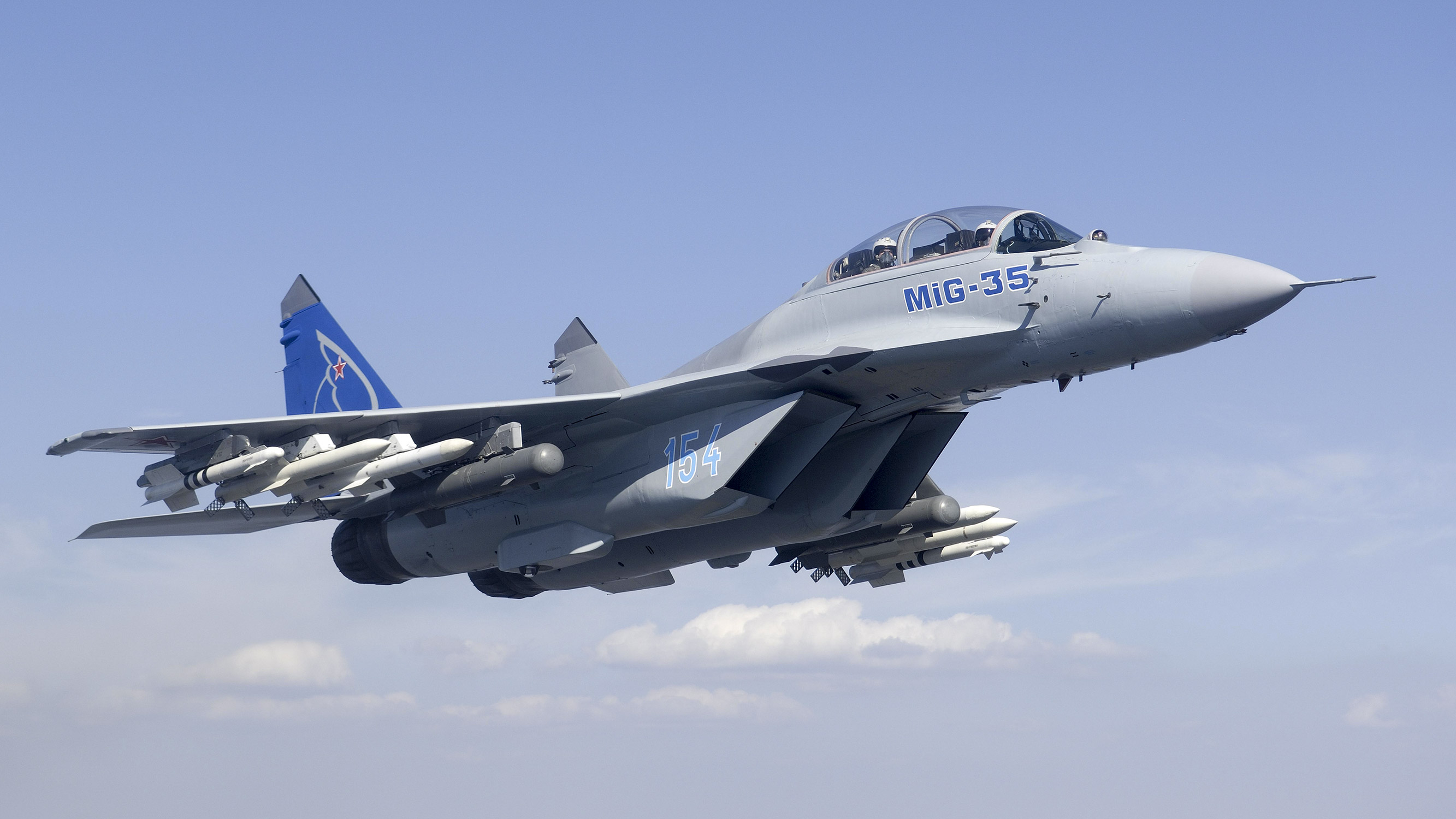

Russia’s MiG-35 doesn’t chase the mystique of fifth-generation stealth fighters — it delivers a more pragmatic solution.
Evolving from the proven MiG-29 lineage, it combines decades of Soviet and Russian design experience into a flexible, cost-effective multirole platform suited for modern air combat.
So let’s break down what it is, how it works, and where it fits today.
At a Glance
| Category: | Details: |
| Type | 4++ generation multirole fighter aircraft |
| Origin | Russia |
| Manufacturer | Mikoyan (United Aircraft Corporation) |
| Role | Air superiority, multirole strike, interception, and reconnaissance |
| Crew | 1 to 2 |
| First Flight and Service Entry | 2007; Late 2010s |
| Base Platform | Advanced evolution of MiG-29M/M2 and MiG-29K |
| Top Speed | Mach 2.25 (2,778 kilometers/1,726 miles per hour) |
| Combat Range | 1,000 kilometers (621 miles) without refueling |
| Ferry Range | Up to 3,100 kilometers (1,926 miles) with external tanks |
| Service Ceiling | 16,000 to 17,500 meters (52,493 to 57,415 feet) |
| Maximum Weapons Load | 6,500 to 7,000 kilograms (14,330 to 15,432 pounds) across 9 to 10 hardpoints |
| Engines | 2 × Klimov RD-33MK turbofans (afterburning) |
| Avionics | AESA radar (Zhuk family), IRST, advanced EW suite |
| Major Competitors | F-16 Fighting Falcon, JAS 39 Gripen, Eurofighter Typhoon, F/A-18E/F Super Hornet, and Chengdu J-10 |
What Is the MiG-35?
The MiG-35 takes the MiG-29’s proven airframe and pushes it into a new generation of combat.
Built to operate in high-threat, layered air defense environments where survivability and adaptability are critical, the MiG-35 shines as a multirole frontline fighter.
Engineered by Mikoyan under the United Aircraft Corporation, the MiG-35 fuses upgraded avionics, advanced sensor suites, and expanded mission systems to hunt, strike, and gather intelligence in rapidly shifting battlefield conditions, all while maintaining full all-weather operational capability.
Origins and Development
The MiG-35 traces its roots to upgrades of the MiG-29 platform, particularly the MiG-29M and MiG-29K variants.
Development accelerated in the 2000s as Russia sought to modernize its tactical aviation fleet while offering an export-friendly alternative to heavier and more expensive fighters.
The aircraft was officially unveiled in 2007 and has since undergone iterative improvements.
It was selected for limited service with Russia, though large-scale procurement has been slower than initially expected, reflecting budget priorities and competition from other platforms, such as the Su-35.
Configurations of the MiG-35 Fighter
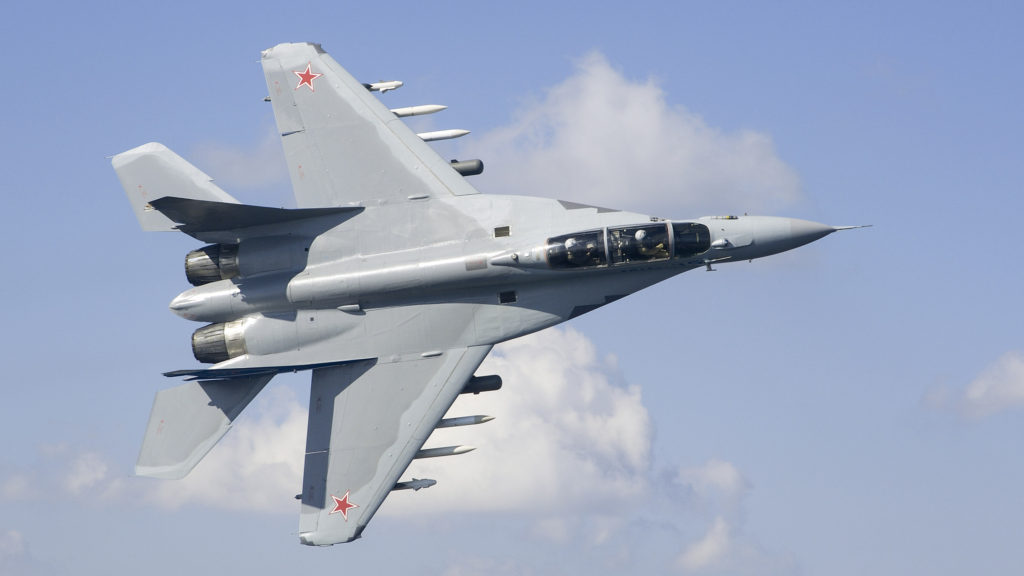
The MiG-35 family includes:
- MiG-35 (single-seat): Standard multirole fighter
- MiG-35D (two-seat): Combat-capable trainer and strike variant
Both variants share similar performance characteristics, with the two-seat version offering enhanced training and mission flexibility.
How the MiG-35 Works
Propulsion and Performance
The MiG-35 is powered by improved RD-33 engines, offering greater thrust, efficiency, and reduced smoke signature compared to earlier MiG-29 variants. Service life has also increased to 4,000 hours.
Some configurations include thrust-vectoring nozzles, enhancing maneuverability in close combat.
Sensors and Avionics
It bears the Zhuk-AE (or Zhuk-AM) radar that allows the aircraft to track up to 30 air targets at ranges of 160 kilometers (99 miles) while engaging six of the most threatening simultaneously.
The MiG-35 is also paired with an advanced optoelectronic targeting system, improving detection, tracking, and engagement across day and night operations.
Together, these systems enable the MiG-35 to identify, prioritize, and engage multiple threats simultaneously.
Weapons and Multirole Capability
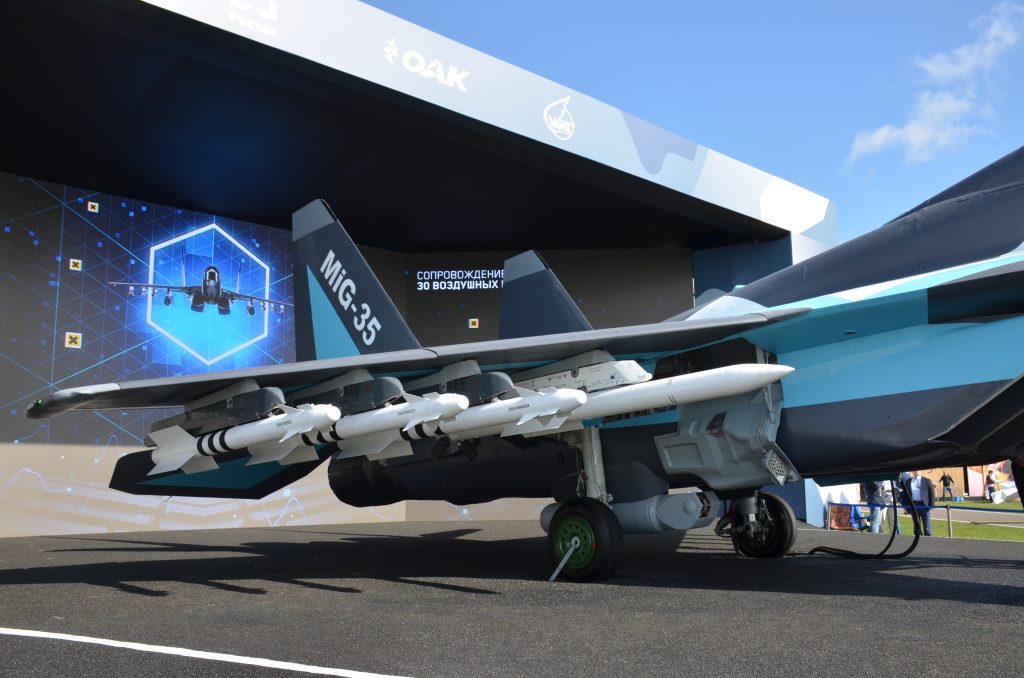
The MiG-35 supports a wide range of air-to-air and air-to-ground weapons, including precision-guided munitions.
Its multirole design allows rapid switching between mission types, making it suitable for diverse operational scenarios.
Strengths
- Multirole combat flexibility: Shifts between air superiority, strike, and reconnaissance within a single sortie.
- Advanced sensor suite: The Zhuk-AE radar combined with electro-optical systems enables long-range detection, multi-target tracking, and high-precision engagement.
- High maneuverability: Thrust vectoring and aerodynamic refinements deliver strong agility in close-range and high-intensity air combat.
- Networked situational awareness: Integrated avionics improve battlefield awareness and enable faster target identification and engagement decisions.
- Cost-efficient capability upgrade: Delivers near–fifth-generation sensor and combat performance at significantly lower acquisition and lifecycle cost.
- Sustained operational efficiency: Modernized systems and improved reliability reduce maintenance burden compared to legacy platforms, supporting longer deployment cycles.
Limitations
- Limited stealth characteristics: Lacks low-observable design features, reducing survivability in highly contested, radar-dense environments compared to fifth-generation fighters.
- Constrained production scale: Limited fleet numbers reduce its overall operational footprint and broader force integration potential.
- Internal competition within fleet mix: Often operates alongside more heavily armed Russian fighters, which can take priority in certain high-end mission profiles.
- Export and market constraints: International adoption is shaped by geopolitical pressures and sanctions, limiting wider global deployment and sales potential.
Global Context and Use
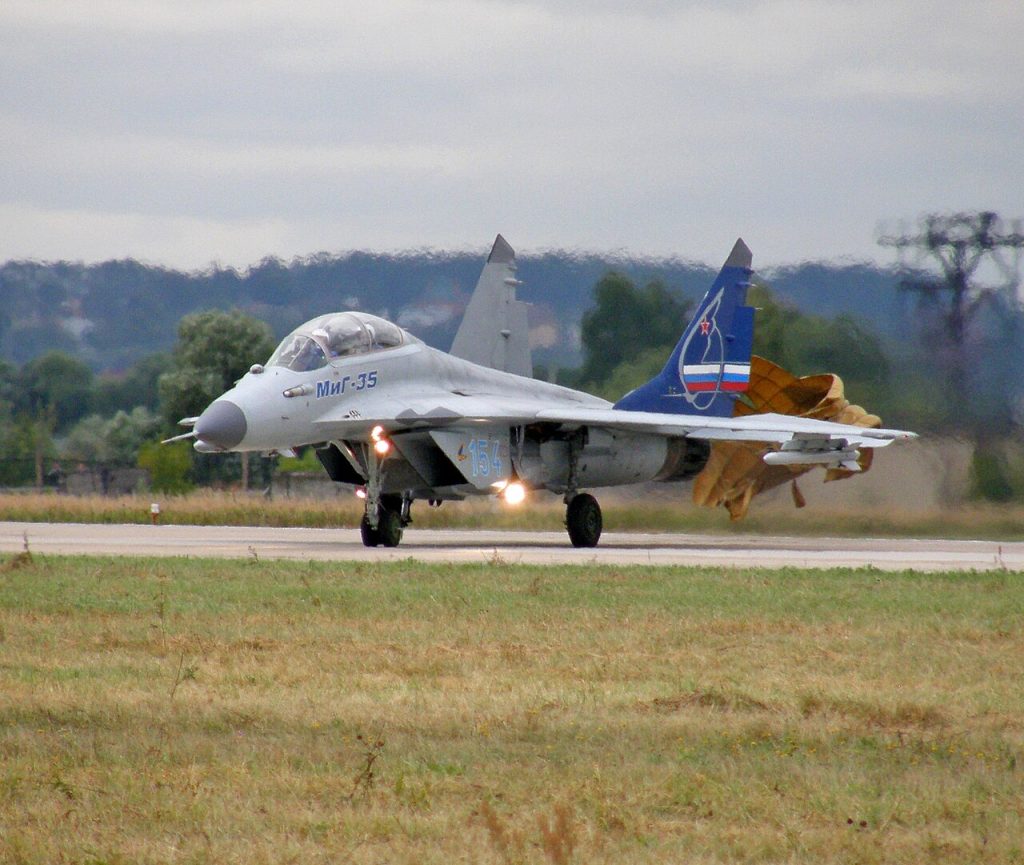
The MiG-35 has seen limited operational deployment, primarily within Russia.
It has been marketed to international customers as an affordable yet capable multirole fighter, though export success has been modest.
Globally, it competes with aircraft such as the American F-16 and China’s JF-17.
The MiG-35 sits between these platforms, offering more advanced sensors and performance than lower-cost fighters but without the stealth and network integration of Western fifth-generation systems.
Future Outlook
The future of the MiG-35 remains uncertain but not irrelevant. As air forces balance cost and capability, there is still a role for advanced non-stealth fighters, particularly for nations that prioritize versatility and affordability over cutting-edge stealth.
Yet the direction of air combat is clear. As stealth, networked warfare, and unmanned systems reshape the battlespace, the MiG-35 may ultimately serve less as a long-term centerpiece and more as a bridge between generations.
In that role, it reflects a broader reality: not every air force needs the most advanced fighter — but every air force needs one that fits its fight.